Basic concepts of space missions
This chapter introduces the basic concepts of space missions and provides the foundational knowledge required for the following sections. Readers who already have experience or familiarity with space systems and mission architecture may choose to skip this chapter.
Space System Model
We will begin by introducing the concept of the Space System Model, defined by the ECSS as a way of representing a space system by decomposing it into elements and the activities associated with them. This concept aims to simplify the understanding of complex space systems by breaking them down into smaller and simpler subsystems. An analogy would be zooming in to observe and understand the individual parts of a larger system.1
The Space System Model is based on functional decomposition, where each category represents a group of physical elements within the mission architecture. A Space System is the highest level of organization in a space mission, encompassing all major elements required to achieve the mission objectives.
Space System
├─ Space Segment
│  ├─ Space Segment System
│  │  ├─ Space Segment Subsystem
│  │  │  ├─ Components/parts
├─ Ground Segment
│  ├─ Ground Segment System
│  │  ├─ Ground Segment Subsystem
│  │  │  ├─ Components/parts
├─ Launch Segment
│  ├─ ...
├─ Support Segment
│  ├─ ...
Example: The Apollo mission
Space System:                       Apollo Program
├─ Space Segment                    Spacecraft
│  ├─ Space Segment System:         Lander Module, Command Module
│  │  ├─ Space Segment Subsystem:   Data Handling
│  │  │  ├─ Components/parts:       On-board Computer
│  │  │  |  ├─ Sub-components:      Processor
├─ Ground Segment
│  ├─ Ground Segment System:        Operations Center
│  │  ├─ Ground Segment Subsystem:  Telecommunications
│  │  │  ├─ Components/parts        Antenna
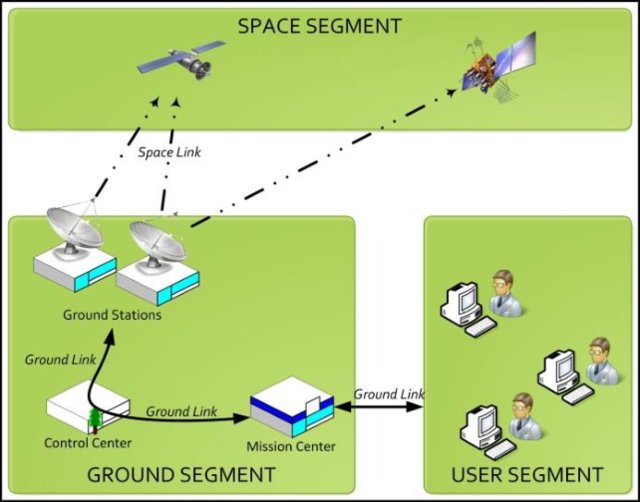
Ground Segment
The Ground Segment (GS) reefers the the part of a space mission located on Earth that is responsible for communicating with, controlling, and supporting the spacecraft. It is
composed by the Ground Station infrastructure, including operation center buildings,
radio systems, antennas, processing units, software, etc.
The Space Segment must be within line of sight to establish communication with the Ground Segment. During this portion of the orbit, contact is established and the communication link is maintained.
Space Segment
The Space Segment is the part of a space mission that operates in space. It includes the spacecraft (such as satellites, rovers, probes, rockets), along with all onboard systems, instruments, and software required to perform the mission and communicate with Earth.
Note that the Space Segment can be compose oif several spacecrafts,
Spacecraft Bus
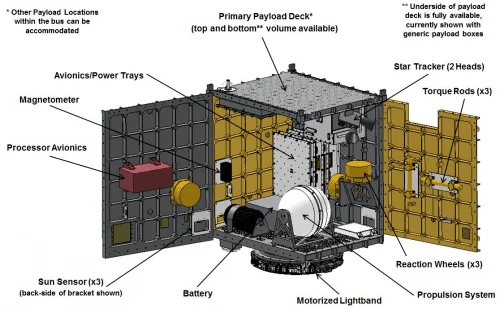
The term spacecraft bus, also known as Platform, in the context of spacecrafts, refers
to the basic structure of the satellite and its subsystems, which house and support the payload.
The bus is composed by:
- Mechanical structure
- Electrical Power Subsystem (EPS)
- Communications Subsystem (COMS)
- Thermal Control Subsystem
- Attitude and Orbit Control Subsystem (AOCS)
- Command and Data Handling Subsystem (CDHS)
...
├─ Space Segment
│  ├─ Spacecraft
│  |  ├─ Satellite Bus
│  |  |  ├─ Mechanical Structure
│  |  |  ├─ Electrical Power Subsystem (EPS) ★
│  |  |  ├─ Attitude and Orbit Control Subsystem (AOCS) ★
│  |  |  ├─ Thermal Control Subsystem
│  |  |  ├─ Command and Data Handling Subsystem (CDHS) ★
│  |  |  ├─ Communications Subsystem (COMS) ★
Note that the bus does not include the payload, his goal is to host and support the payload.
Tip
Most satellites are distributed computing systems, meaning they host a collection of independent computers. It is very common for the CDHS, COMS, AOCS, EPS, and payload to each have their own dedicated computer (or several computers), and therefore each subsystem requires its own flight software. However, we will focus on the CDHS, as it serves as the central element for data handling and overall system coordination.
Note
In some cases, when satellites are very simple, they may not be distributed systems but instead host a single computer responsible for all functions across all subsystems.
Payload
Space missions are developed to achieve specific objectives, such as taking images of the Earth or stars, measuring the characteristics of planets, or providing communication services. These objectives are accomplished through specialized instruments or technologies known as the payload.
This Payload is the primary reason for the mission and the satellite's existence.
Examples of payloads include radars, cameras, telescopes, and telecommunications equipment.
...
├─ Space Segment
│  ├─ Spacecraft
│  |  ├─ Satellite Bus
│  |  ├─ Payload
Command and Data Handling Subsystem
The CDHS consist of the electronics and software used to receive and distribute commands, and to store and transmit scientific data and telemetry. 2 Its main tasks are:
- Receive commands from ground through the Communications Subsystem (COMS).
- Control the other subsystems and the payload.
- Collect and store telemetry from the entire system.
- Collect and store scientific data.
- Transmit the collected data to the ground through COMS.
Tip
In summary: the CDHS is the interface between the Ground Segment and the Space Segment (subsystems and payload).
The design of the Command and Data Handling System (CDHS) varies from mission to mission, depending on specific requirements and objectives. However, it typically consists of several essential components, including an On-Board Computer (OBC), data storage units, a data bus for inter-system communication, and the flight software responsible for coordinating and controlling overall system operations.
On-board Computer
The central and main component of the CDHS is the On-Board Computer (OBC), which is an embedded system responsible for coordinating and executing the system’s core functions.
Like the CDHS, the design of the OBC varies from mission to mission. The main elements of an OBC include a processor, RAM memory, non-volatile memory, and communication interfaces. These components are typically used redundantly, meaning that more than one element of the same type performs exactly the same function in order to ensure fault tolerance in case of failures.
Differences between OBCs and ground-based computers
| OBC (On-Board Computer) | PC (Ground Computer) |
|---|---|
| Custom embedded system | Standardized and Commercial-off-the-shelf |
| Very high cost | Low cost, often disposable |
| Mechanically robust to withstand launch vibrations and accelerations | Not designed for extreme mechanical loads |
| Must withstand space conditions: vacuum, thermal cycles, and radiation | Operates in controlled Earth environments |
| Very limited power budget | Virtually unlimited power budget |
| Reliability is a top priority | Reliability is not the primary focus |
-
European Cooperation for Space Standardization. Space Engineering: Test and Operations Procedure Language. Technical Standard ECSS-E-ST-70-32C, European Cooperation for Space Standardization (ECSS), 2008. URL: https://ecss.nl/standard/ecss-e-st-70-32c-test-and-operations-procedure-language/. ↩
-
James R. Wertz, David F. Everett, and Jeffery J. Puschell, editors. Space Mission Engineering: The New SMAD. Volume 28 of Space Technology Library. Microcosm Press, Hawthorne, CA, 2011. ISBN 9781881883166. URL: https://books.google.com/books/about/Space_Mission_Engineering.html?id=4JM7tAEACAAJ. ↩